 Also, this rotating text:
Monday, October 08, 2007
Troubleshootize
It's nice to see companies with a sense of humor. This one is from Feedburner:
 Also, this rotating text:
Also, this rotating text:


Thursday, September 13, 2007
Reverse /. Effect
On September 8, Slashdot posted a front-page article pleading for more volunteers to join the pool.ntp.org project. It worked:

This is the first time I've ever seen the /. effect actually lower the load on servers!

This is the first time I've ever seen the /. effect actually lower the load on servers!
Tuesday, July 10, 2007
China's solution to food safety? Capital punishment.
China just executed its former chief of the State Food and Drug Administration, Zheng Xiaoyu. He was convicted of dereliction of duty and taking bribes to approve unsafe goods. Yes, he was corrupt and deserved to go to prison, but execution? The sentence was set on May 29 (2007) and he was executed just 42 days later.
The Chinese government is worried about their ability to export food and drugs, and they should be, given that they put antifreeze in toothpaste because it costs less than other, non-toxic sweeteners. Recently, they also exported snacks tainted with salmonella.
But seriously... do they really think swift executions are going to give them good press? Especially considering the West's already critical opinion of human rights in the PROC?
The Chinese government is worried about their ability to export food and drugs, and they should be, given that they put antifreeze in toothpaste because it costs less than other, non-toxic sweeteners. Recently, they also exported snacks tainted with salmonella.
But seriously... do they really think swift executions are going to give them good press? Especially considering the West's already critical opinion of human rights in the PROC?
Wednesday, June 27, 2007
The iPhone is overrated

The amount of press the iPhone is getting is absurd. The phone is horrendously incomplete for the price. The iPhone has none of the following (from Gizmodo):
- Songs as Ringtones
- Games
- Flash support
- Instant Messaging
- Picture messages (MMS)
- Video recording
- Voice recognition or voice dialing
- Wireless Bluetooth Stereo Streaming (A2DP)
- One-size-fits-all headset jack (May have to buy an adapter for certain headphones)
- 3G (EV-DO/HSDPA)
- GPS
- A real keyboard
- Removable battery
- Expandable Storage
- Direct iTunes Music Store Access (Over Wi-Fi or EDGE)
- Only works with AT&T Wireless (Cingular)
- Can't be sold without a contract
[Update 7/11]: Will it blend? Yes, it will.
Monday, June 25, 2007
New CNN.com

CNN.com is going to update their website this coming weekend. I stumbled upon their beta site yesterday and was planning to write a design commentary today, but the beta is over and the page now redirects to their web design blog. Oh well.
Apparently it's been up since the beginning of June, and a number of sites have already reviewed it. At the time I am writing this, there is still a guided tour available, too.
I really like the new design. The overall look has been simplified and streamlined, and there is a more consistent use of color across the site. Gone are the gradients galore in menus and buttons. Distinct sections of the pages are more clearly defined as well. From a technology standpoint, the site makes heavy use of Ajax and cleanly integrates video into the site, a step up from their old pop-up solution, which was just awful. Video will also be entirely free now (though ad-crippled).
Users will be able to customize their pages somewhat, but only in regards to localization... at first. The compartmentalization of the various page components hints that they might be moving toward a more Yahoo-like portal environment.
CNN's approach to the creation of the new site is also encouraging. The beta was plastered with feedback links, and the blog actively sought comments from users. Though not exactly collaborative design, for such a high-profile site like CNN.com to actively solicit user feedback is a good sign of things to come.
[Update 6/30]: It went live today. The front page was so intuitive, I didn't even realize it had been refreshed for a minute!
Sunday, June 24, 2007
Italia
We're going to Italy this August! In a tradition that is almost never broken, one must embark on a Bar Trip shortly after finishing the Bar exam, before starting a full time job. We've always wanted to visit Italy, and a family member gave us the tour catalog that does guided tours all over the world.
So, we took the plunge. It's 3 nights each in Rome, Florence, and Venice. The tour company is handy because they take care of your airfare, hotels, transportation, and a bunch of tours. They also give you a fair amount of downtime, for relaxing or touring on your own.
Jason is going to photoblog his trip to Europe, so I guess when we go I'll put a photoblog here.
So, we took the plunge. It's 3 nights each in Rome, Florence, and Venice. The tour company is handy because they take care of your airfare, hotels, transportation, and a bunch of tours. They also give you a fair amount of downtime, for relaxing or touring on your own.
Jason is going to photoblog his trip to Europe, so I guess when we go I'll put a photoblog here.
Friday, June 22, 2007
Your tax dollars at work

Fun facts about people running the country:
- Scott Charbo, the Chief Information Officer of the Department of Homeland Security, has a Masters in plant science*. In his 2 years as CIO, he has racked up almost $6 billion in IT expenditures. The DHS sustained over 800 IT security breaches during that time.
- Dick Cheney's office tried to dissolve the Information Security Oversight Office, a division of the National Archives. The office is charged with auditing the classification and declassification of information by the government. Cheney's office feels that it is exempt from this executive order, and when challenged by the office, Cheney tried to eliminate it. The initiative was established by Clinton and amended by Bush in 2003.
Thursday, June 21, 2007

Tuesday, December 13, 2005
Worried About Rats?
From PCConnection.com:
"Worried about rats nibbling on your computer component cables? Need to get that computer off the floor but it won't mount into your rack or cabinet. This aluminum equipment shelf mounts into the aluminum distribution rack and those dirty rats won't get near your high-end equipment. The Belkin black vented Equipment Shelf (19"W x 14"D) is a single sided equipment shelf used with the Aluminum Distribution Rack to support equipment that cannot be mounted."
"Worried about rats nibbling on your computer component cables? Need to get that computer off the floor but it won't mount into your rack or cabinet. This aluminum equipment shelf mounts into the aluminum distribution rack and those dirty rats won't get near your high-end equipment. The Belkin black vented Equipment Shelf (19"W x 14"D) is a single sided equipment shelf used with the Aluminum Distribution Rack to support equipment that cannot be mounted."
Monday, December 12, 2005
FlightAware.com
Take a look at FlightAware.com. The live tracking is interesting, but I thought the time lapse animation was totally awesome (QuickTime required).
Tuesday, December 06, 2005
Deciphering Viruses
I read a great post on F-Secure's weblog about Old skool virus fighting. It's a bit technical, but it explains a great deal about how viruses used to be written, and the methods to triage, identify, catalog, and write removal tools for malicious software.
Much of the article is applicable to modern software.
Much of the article is applicable to modern software.
Wednesday, November 16, 2005
Baba Yetu
A few days ago, I got around to firing up Civilization IV and playing it some. My impression of the game is for another time; today is about the title theme, Baba Yetu.
I couldn't tell what language it was at first, but after a few times through I decided it must be Swahili or a similar language. Now I don't know very much about Swahili at all, but I was able to pick out the phrase "baba yetu" from the lyrics, and googled it.
(I just realized I didn't capitalize "googled". Is it becoming as ubiquitous as xerox, kleenex, and internet?)
It turns out that "Baba Yetu" is Swahili for "Our Father", and that the entire song is the Lord's Prayer, slightly rearranged for musical continuity. Wow. I found the actual prayer on Wikisource and the song lyrics (in both Swahili and English) on civfanatics.com. Those people are nuts, by the way.
The music itself is beautiful. It begins with tribal instrumental and vocal overtones, but the soft cymbal sweep and C-C-a-FG chord progression foreshadow something more culturally mixed. And as if my thoughts alone created action, the moment I sensed this, so it was. The second repetition of the chorus fills in the aural palette with a rich vocal harmony and beating percussion that offsets the tribal portion magnificently. Right then, the sun rises over Europe, Africa, and Middle Asia on the title screen.
As the verses progress, more and more modern instruments add their part to the whole, starting with simple strings and leading to more complicated brass timbres. The evolution mirrors, to some degree, the progression of our music and technology as a world. Quite fitting for Civilization.
The instrumentation is not the only part of the song that evolves. In the B part, careful listeners will recognize the a-F-C-G pattern that is so pervasive in modern music. I thought that was a nice touch.
Maybe I read into it too much. Even without any interpretation, the piece is exquisite. It's the perfect opener for Civilization IV.
I couldn't tell what language it was at first, but after a few times through I decided it must be Swahili or a similar language. Now I don't know very much about Swahili at all, but I was able to pick out the phrase "baba yetu" from the lyrics, and googled it.
(I just realized I didn't capitalize "googled". Is it becoming as ubiquitous as xerox, kleenex, and internet?)
It turns out that "Baba Yetu" is Swahili for "Our Father", and that the entire song is the Lord's Prayer, slightly rearranged for musical continuity. Wow. I found the actual prayer on Wikisource and the song lyrics (in both Swahili and English) on civfanatics.com. Those people are nuts, by the way.
The music itself is beautiful. It begins with tribal instrumental and vocal overtones, but the soft cymbal sweep and C-C-a-FG chord progression foreshadow something more culturally mixed. And as if my thoughts alone created action, the moment I sensed this, so it was. The second repetition of the chorus fills in the aural palette with a rich vocal harmony and beating percussion that offsets the tribal portion magnificently. Right then, the sun rises over Europe, Africa, and Middle Asia on the title screen.
As the verses progress, more and more modern instruments add their part to the whole, starting with simple strings and leading to more complicated brass timbres. The evolution mirrors, to some degree, the progression of our music and technology as a world. Quite fitting for Civilization.
The instrumentation is not the only part of the song that evolves. In the B part, careful listeners will recognize the a-F-C-G pattern that is so pervasive in modern music. I thought that was a nice touch.
Maybe I read into it too much. Even without any interpretation, the piece is exquisite. It's the perfect opener for Civilization IV.
Monday, November 07, 2005
Avian Flu
A lot of people have been worried about the Avian Flu virus recently. I find this rather silly. This is what happens when people let the media replace science. There's nothing new about this concept, by the way (great article; you should read the whole thing).
The media is what really makes it so bad. While it's uncommon for CNN to stoop to fear mongering, take a look at the title of this article: "WHO: Human flu pandemic inevitable". Wow. Inevitable? This just in: "Astronomer: Sun Decaying to Black Hole Inevitable!"
How about "CDC: Mutated Rhinovirus Strains Found", otherwise worded as "Human Cold Virus Mutates All the Time and Each Cold You Ever Get is Typically a Freshly Mutated Strain".
Sometimes, irresponsible media can be worse than most people imagine. The media prey on people's most recent fears. Remember when some woman was arrested for bringing nail clippers onto a plane? Remember all the media hype about it? Were nail clippers ever a security risk? Of course not. No more than a sharpened pencil is. Last I checked, they still allowed sharpened pencils on airplanes.
Here's a great article about Avian Flu, written by a much better author than myself. Watch out for that Klebsiella bacteria!
The media is what really makes it so bad. While it's uncommon for CNN to stoop to fear mongering, take a look at the title of this article: "WHO: Human flu pandemic inevitable". Wow. Inevitable? This just in: "Astronomer: Sun Decaying to Black Hole Inevitable!"
How about "CDC: Mutated Rhinovirus Strains Found", otherwise worded as "Human Cold Virus Mutates All the Time and Each Cold You Ever Get is Typically a Freshly Mutated Strain".
Sometimes, irresponsible media can be worse than most people imagine. The media prey on people's most recent fears. Remember when some woman was arrested for bringing nail clippers onto a plane? Remember all the media hype about it? Were nail clippers ever a security risk? Of course not. No more than a sharpened pencil is. Last I checked, they still allowed sharpened pencils on airplanes.
Here's a great article about Avian Flu, written by a much better author than myself. Watch out for that Klebsiella bacteria!
Thursday, October 20, 2005
The First REAL Projector?
Finally. A projector that does things a projector should.
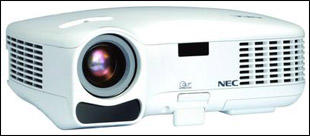
From the website: "As the worldÂ’s first automatic projector sporting a footprint smaller than a sheet of paper, the LT35 is bright, powerful and packed with technological innovations way ahead of its time. This little powerhouse does everything for automatically including start-up, focus, keystone correction and cool down."
I've been saying for a while that projectors are not user friendly. When a $50 camera can autofocus, you would expect that a $2000 projector would also. Unfortunately, we have become brainwashed consumers and buy buy buy anyway, without regard to quality requirements like this. Hopefully it will also scan all inputs simultaneously. There's no excuse for taking 20 seconds to acquire a signal.
From the website: "As the worldÂ’s first automatic projector sporting a footprint smaller than a sheet of paper, the LT35 is bright, powerful and packed with technological innovations way ahead of its time. This little powerhouse does everything for automatically including start-up, focus, keystone correction and cool down."
I've been saying for a while that projectors are not user friendly. When a $50 camera can autofocus, you would expect that a $2000 projector would also. Unfortunately, we have become brainwashed consumers and buy buy buy anyway, without regard to quality requirements like this. Hopefully it will also scan all inputs simultaneously. There's no excuse for taking 20 seconds to acquire a signal.
Wednesday, October 19, 2005
What are you reading?
Okay, me first.
 Joel on Software
Originally a weblog only, Joel Spolsky writes about the various challenges of software development. He talks about issues like Unicode, scheduling, project management, entrepreneurship, and the like. I don't agree with everything he says, and I wouldn't make it required reading at any organization, but there are definitely some good reads in there. I found the humor... ok. A worthwhile read.
$16.49 on Amazon.com
 Secrets & Lies: Digital Security in a Networked World
Crypto legend Bruce Schneier's definitive Applied Cryptography is the tome for understanding crypto. But the book led people to believe that encryption solves all the world's security problems. This book clarifies that misconception. It takes a step back and explains what security really is: risk management. What, exactly, are we trying to secure, from whom, and for what purpose? Those are the quintessential questions, not "Which file extensions should we block?". It's designed to be read from beginning to end, so it's not a reference, and it takes a while to get though.
It's easy enough to read for a non-technical person, too. Biggest downside was that Schneier couldn't help but plug his company, but it doesn't interfere too much. A great read for IT folk and anyone who wants to know what computer security is really all about.
$12.21 on Amazon.com
What useful (non-fiction) books are you reading?
Joel on SoftwareOriginally a weblog only, Joel Spolsky writes about the various challenges of software development. He talks about issues like Unicode, scheduling, project management, entrepreneurship, and the like. I don't agree with everything he says, and I wouldn't make it required reading at any organization, but there are definitely some good reads in there. I found the humor... ok. A worthwhile read.
$16.49 on Amazon.com
Secrets & Lies: Digital Security in a Networked WorldCrypto legend Bruce Schneier's definitive Applied Cryptography is the tome for understanding crypto. But the book led people to believe that encryption solves all the world's security problems. This book clarifies that misconception. It takes a step back and explains what security really is: risk management. What, exactly, are we trying to secure, from whom, and for what purpose? Those are the quintessential questions, not "Which file extensions should we block?". It's designed to be read from beginning to end, so it's not a reference, and it takes a while to get though.
It's easy enough to read for a non-technical person, too. Biggest downside was that Schneier couldn't help but plug his company, but it doesn't interfere too much. A great read for IT folk and anyone who wants to know what computer security is really all about.
$12.21 on Amazon.com
What useful (non-fiction) books are you reading?
Thursday, October 13, 2005
Mousepad Attacks and How to Beat Them
It’s 8:55 AM. You sit down at your desk with your Dunkin’ Donuts Turbo Ice Latte (with Splenda, not sugar), and start checking your email. The first one reads:
Dear valued employee,
Effective immediately, all passwords must be at least 12 characters long, contain no vowels, and contain at least 5 symbol characters. We think this is more secure. All current passwords will expire at 5PM. We appreciate you continued cooperation in keeping our company a secure place to work.
Thank you,
IT Team
Riiiight … next email. You go about your normal business, writing memos you hope nobody reads, sorting all your files by color, or whatever it is people do at work during the day. Five o’clock rolls around and, suddenly, your applications close and you see a big prompt: “PLEASE CHANGE YOUR PASSWORD:”.
“So they weren’t just pulling my leg,” you think. “Oh well... what was that requirement again? FIVE symbols?” Oh, a password generation button. That makes it easy!
xX@`5m,2’p9QL{_;
Oh sure, that’s easy to remember. How about a mnemonic? You heard that makes remembering passwords easier. “xenophobic Xylophones money backtick...” No, that won’t work. You’ve got it! Write it on a Post-It and stick it to the monitor! But, hmm, that doesn’t seem very safe. What if someone just walks by and reads it? You have sensitive data on this computer. Plus, that’s against corporate policy and you could get in trouble.
Aha! Write it on a Post-It, and then stick it to the bottom of your mousepad! Nobody will look there. Plus, you can discretely check it without anyone noticing that you wrote down the password. Problem solved.
* * *
Let’s back up and look at what just happened. Somebody decided that four number passwords were not secure because they were too easy to guess (I claim that this is debatable but that argument is for another time). In order to be secure, they argue, passwords must be X length and have Y characteristics. This makes them harder to break. It also makes them much harder to remember.
Security is not a technology problem. Security is a people problem.
People can’t, and shouldn’t be expected to remember long, random passwords with symbols in them. Maybe given practice, someone could eventually remember one password. But people are expected to remember dozens of these. Ideally, one for each account that they have. Your eBay password should be different from your Bank of America password, etc. Personally, I have at least 30 online accounts that I need to keep track of, probably more that I don’t even remember. And I’m expected to remember that many different passwords?
I don’t think so.
What to do? I could have one password and use it for everything. But is that a good idea? What if someone watches me type it? What if an evil librarian reads my password as I log into librarybooks-r-us.com and then uses it to wire money from my bank account? Clearly I don’t want the same password for everything.
I could write down all my accounts with the corresponding user names and passwords, and keep it in my wallet. This is not a bad idea. Most people are pretty careful about protecting their wallets. If your wallet is stolen, some badguy somewhere now has your ATM card, credit card, and a whole lot of identification about you. Maybe your health insurance number is the same as your social security number. Congratulations, thief, you can now register credit cards in the victim’s name.
You can cancel your credit card, invalidate your ATM card, and get a replacement driver’s license. But what about all those passwords? You might not even remember what the accounts even are, let alone their passwords. Here’s a trick: swap the last and first letters of the password when you actually go to type it in. So if your password was really “abcdefg”, you would write down “gbcdefa” on your cheat sheet, and not tell anybody your little secret. That’s a very simple way to encrypt your passwords (as long as they don’t know how to unscramble the code).
Even with a garbled cheat sheet, though, it’s still going to be annoying to type in xX@`5m,2’p9QL{_; every time you want to log in to librarybooks-r-us.com. That’s going to take at least 20 seconds to type in unless you’re a very fluent typist. If only there were a program out there that would let you:
Oh yeah, one more thing... 4. I don’t want to pay anything for it.
I bet you can guess what I’m about to say next. Password Safe is a free tool from Counterpane Systems (i.e. Bruce Schneier) that does just that. It allows you to type in the user name and password for any system, and it remembers them all. You can name each account/password pair and create groups of accounts. For example, separate groups for “Personal” and “Work”.
That covers requirement 1. For requirement 2, the entire list of accounts is encrypted by one master password. This becomes the one password that you have to remember. This is a good one to scramble and put in your wallet.
For requirement 3, you simply double click on an account, and the password is placed in the computer’s clipboard. Now you can simply paste it into the password field. This allows you to securely log in without even remembering the password. You wouldn’t want a list of all the passwords exposed when someone was watching you over your shoulder.
And yes, it’s free.
Here’s where to get it: http://passwordsafe.sourceforge.net/
Dear valued employee,
Effective immediately, all passwords must be at least 12 characters long, contain no vowels, and contain at least 5 symbol characters. We think this is more secure. All current passwords will expire at 5PM. We appreciate you continued cooperation in keeping our company a secure place to work.
Thank you,
IT Team
Riiiight … next email. You go about your normal business, writing memos you hope nobody reads, sorting all your files by color, or whatever it is people do at work during the day. Five o’clock rolls around and, suddenly, your applications close and you see a big prompt: “PLEASE CHANGE YOUR PASSWORD:”.
“So they weren’t just pulling my leg,” you think. “Oh well... what was that requirement again? FIVE symbols?” Oh, a password generation button. That makes it easy!
xX@`5m,2’p9QL{_;
Oh sure, that’s easy to remember. How about a mnemonic? You heard that makes remembering passwords easier. “xenophobic Xylophones money backtick...” No, that won’t work. You’ve got it! Write it on a Post-It and stick it to the monitor! But, hmm, that doesn’t seem very safe. What if someone just walks by and reads it? You have sensitive data on this computer. Plus, that’s against corporate policy and you could get in trouble.
Aha! Write it on a Post-It, and then stick it to the bottom of your mousepad! Nobody will look there. Plus, you can discretely check it without anyone noticing that you wrote down the password. Problem solved.
* * *
Let’s back up and look at what just happened. Somebody decided that four number passwords were not secure because they were too easy to guess (I claim that this is debatable but that argument is for another time). In order to be secure, they argue, passwords must be X length and have Y characteristics. This makes them harder to break. It also makes them much harder to remember.
Security is not a technology problem. Security is a people problem.
People can’t, and shouldn’t be expected to remember long, random passwords with symbols in them. Maybe given practice, someone could eventually remember one password. But people are expected to remember dozens of these. Ideally, one for each account that they have. Your eBay password should be different from your Bank of America password, etc. Personally, I have at least 30 online accounts that I need to keep track of, probably more that I don’t even remember. And I’m expected to remember that many different passwords?
I don’t think so.
What to do? I could have one password and use it for everything. But is that a good idea? What if someone watches me type it? What if an evil librarian reads my password as I log into librarybooks-r-us.com and then uses it to wire money from my bank account? Clearly I don’t want the same password for everything.
I could write down all my accounts with the corresponding user names and passwords, and keep it in my wallet. This is not a bad idea. Most people are pretty careful about protecting their wallets. If your wallet is stolen, some badguy somewhere now has your ATM card, credit card, and a whole lot of identification about you. Maybe your health insurance number is the same as your social security number. Congratulations, thief, you can now register credit cards in the victim’s name.
You can cancel your credit card, invalidate your ATM card, and get a replacement driver’s license. But what about all those passwords? You might not even remember what the accounts even are, let alone their passwords. Here’s a trick: swap the last and first letters of the password when you actually go to type it in. So if your password was really “abcdefg”, you would write down “gbcdefa” on your cheat sheet, and not tell anybody your little secret. That’s a very simple way to encrypt your passwords (as long as they don’t know how to unscramble the code).
Even with a garbled cheat sheet, though, it’s still going to be annoying to type in xX@`5m,2’p9QL{_; every time you want to log in to librarybooks-r-us.com. That’s going to take at least 20 seconds to type in unless you’re a very fluent typist. If only there were a program out there that would let you:
- Store all your passwords, for any system, on the computer
- Prevent anyone from stealing or viewing the list of passwords
- Save you the time of typing the passwords in
Oh yeah, one more thing... 4. I don’t want to pay anything for it.
I bet you can guess what I’m about to say next. Password Safe is a free tool from Counterpane Systems (i.e. Bruce Schneier) that does just that. It allows you to type in the user name and password for any system, and it remembers them all. You can name each account/password pair and create groups of accounts. For example, separate groups for “Personal” and “Work”.
That covers requirement 1. For requirement 2, the entire list of accounts is encrypted by one master password. This becomes the one password that you have to remember. This is a good one to scramble and put in your wallet.
For requirement 3, you simply double click on an account, and the password is placed in the computer’s clipboard. Now you can simply paste it into the password field. This allows you to securely log in without even remembering the password. You wouldn’t want a list of all the passwords exposed when someone was watching you over your shoulder.
And yes, it’s free.
Here’s where to get it: http://passwordsafe.sourceforge.net/
Tuesday, October 11, 2005
In the beginning...
Welcome to my mind.
This journey will take you through depths of thought and contemplation of somebody else... me. Much of what you see you may not understand or care about. And that will be too bad. Please refrain from throwing any foreign objects from the vehicle during the ride. It might give me a headache.
All sentences are to be preceeded with "In my opinion,"
Some things I will not make this blog:
This journey will take you through depths of thought and contemplation of somebody else... me. Much of what you see you may not understand or care about. And that will be too bad. Please refrain from throwing any foreign objects from the vehicle during the ride. It might give me a headache.
All sentences are to be preceeded with "In my opinion,"
Some things I will not make this blog:
- A list of whines and complaints. I'll throw them in when I think they might be interesting to someone else, such as "Be careful buying milk from Store 24. I opened a fresh gallon to find that it was in fact primer paint."
- A list of links to other places without any interesting insights or comments.
- Politically or socially correct.
- "Here's an itinerary of everything I did today. And yesterday. And the day before."
Subscribe to:
Posts (Atom)